
Confessions of a First-Time Conference Speaker
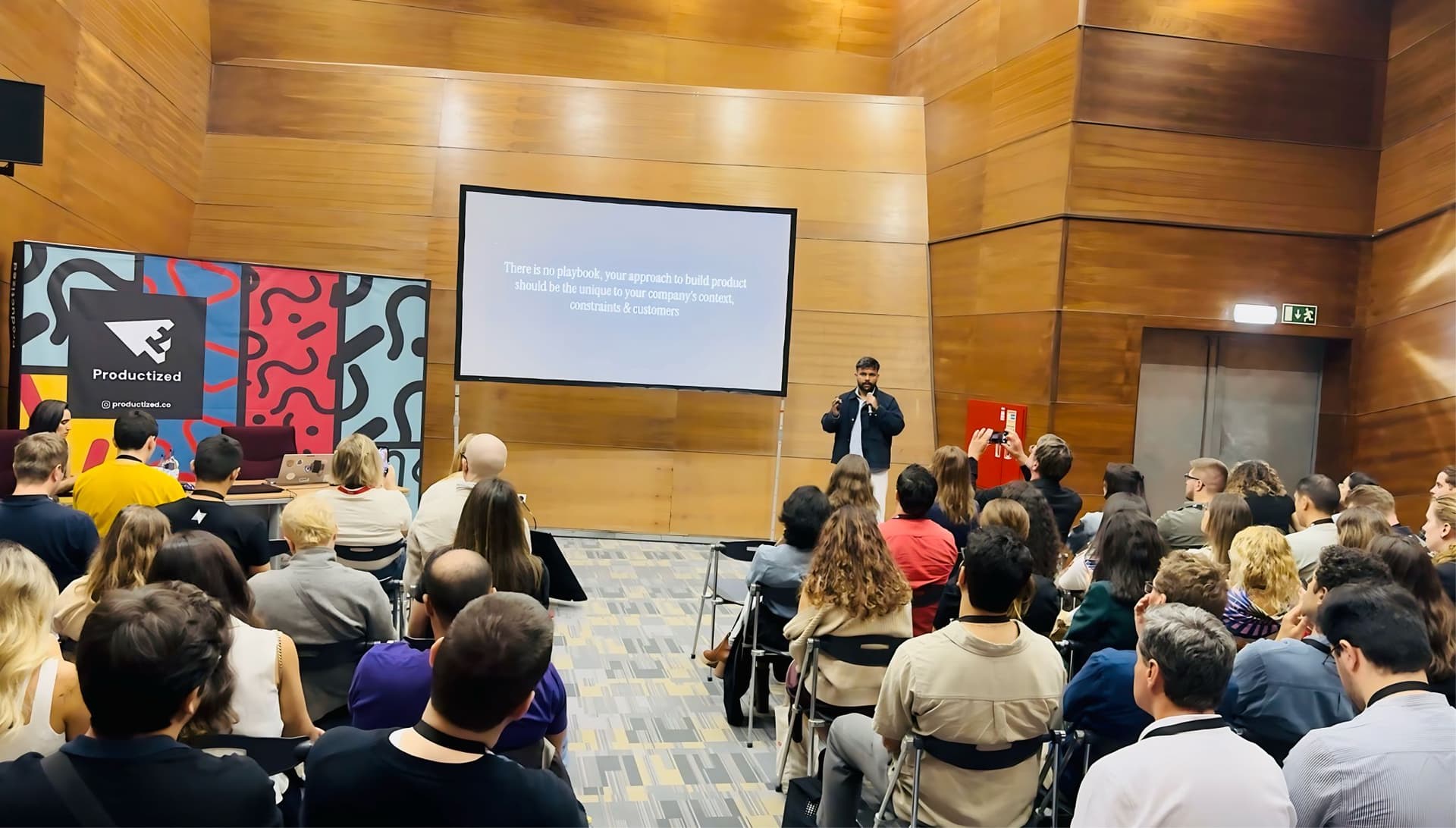
Earlier this October, I did something I was never 100% sure I was qualified to do: I spoke at the Productized conference in Lisbon.
This was my first time ever speaking at a conference. And if I’m being completely honest, right up until I stepped on stage, I felt like a massive impostor.
Even with 12 years of work under my belt, including the last five in product, a voice in my head kept asking, "Who am I to stand in front of other product managers and leaders and give my opinion? Who am I to tell them how products should be built?"
When I first received the invitation, this feeling of imposter syndrome almost made me decline. I didn't see myself as the "expert" on stage.
So, I made a decision. I wouldn't go up there and preach. I wouldn't offer a universal formula or a magic framework. Instead, I would just tell my story.
My talk focused on my experience building products for enterprise customers. Specifically, I shared the raw learnings from the last three years of my life, building a product for a business that was heavily reliant on a few high-ticket enterprise clients.
This is a world I feel is often ignored in the mainstream product conversation.
So much of the product knowledge out there is geared toward B2C or large-scale, self-serve B2B products like Jira, Notion, or Linear. There’s very little written about the messy reality of building when your entire business depends on a handful of powerful customers. What do you do when you have high stakes and low volume?
I didn't have a "5-Step Plan." I just had my experience. I shared what we did, what the outcomes were, and what I learned.
My central message, the one I felt was true to my core, was this:
The way you build a product is largely defined by your context, your constraints, and your customers. There is no single playbook that will work for everyone.
My experience in Lisbon, both as a speaker and an audience member, solidified a feeling I’ve had for a long time. I watched many other speakers—consultants, authors, and product leaders who have achieved considerable success—and I noticed a theme.
Many talks, however well-intentioned, default to: "Here is the formula. This is how you should build products."
I wish this would change.
I wish more speakers would share how they built products, not just what they built.
- What were the real-world roadblocks they hit?
- Why was it a collective effort, not the act of a single visionary?
- How is building a product less like following a blueprint and more like navigating a ship in a storm?
Success is never about one single thing that worked. It's a messy, complex culmination of timing, people, and a thousand small decisions. I believe that's the reality, and we should be more open about it.
This obsession with frameworks often feels like a "makeshift" solution. It gives the feeling of progress and productivity, but it doesn't lead to meaningful results because it ignores the most important factor: your unique context.
Instead of hunting for the perfect template, the approach should be continuous learning. "Based on my constraints and my customers, how do I approach this problem? When I hit a point of friction, how do I build in a check and balance to fix it?"
So, how did it go? Honestly, I enjoyed it.
In hindsight, I felt I might have gone into too much detail on certain things. But at the same time, I felt those details were essential. You can't just share the "what we learned" without giving the context of "what we did" and "what happened."
Public speaking is clearly a skill. I could see how polished the seasoned consultants and authors were. But for me, I'm only comfortable speaking about what I genuinely believe in. And I don't believe in a single formula that makes someone a "better" product manager.
If I ever do this again, I'll stick to the same approach:
"Hey, this was the problem I faced. This is what I did. This is what I learned. My learnings are specific to my context, and they may be very different from yours. But maybe, just maybe, there's a small piece in my story that you can take away."
The best part of the conference was meeting other people in the product space, sharing experiences, and hearing their stories. It made me wish conferences were less "one-to-many" and more collaborative—imagine a room of all the fintech PMs, or all the B2B SaaS PMs, just sharing problems and discussing approaches. That cross-pollination feels so much more valuable.
Ultimately, I'm glad I pushed past the imposter syndrome and did it. But I don't think I'll be joining the "speaker circuit." I want to get back to what I love: building products.
And if, down the line, I learn something else I feel is genuinely interesting and worth sharing with the world... then maybe I'll think about it again. But I am good for now!